

Hiking the Haute Route from Chamonix, France to Zermatt, Switzerland is an unforgettable trek between two of the most famous towns in the Alps. As charming as these two mountain towns are in their own right, there is no arguing that they owe much of their fame to their iconic mountain peaks, Mont Blanc in Chamonix and the Matterhorn above Zermatt. Instantly recognizable and utterly compelling, each of these peaks has a fascinating story reaching far beyond their sheer size and imposing presence in the landscape.
The Mont Blanc Massif
The Hiker’s Haute Route starts in Chamonix, France. It’s no coincidence that this place, presided over by the highest peak in Western Europe, is also the birthplace of modern alpinism. At 4,806m (14,400 feet) in elevation, the towering Mont Blanc, which simply translates to White Mountain, owes its name to the glaciers and snow that blanket it year round.
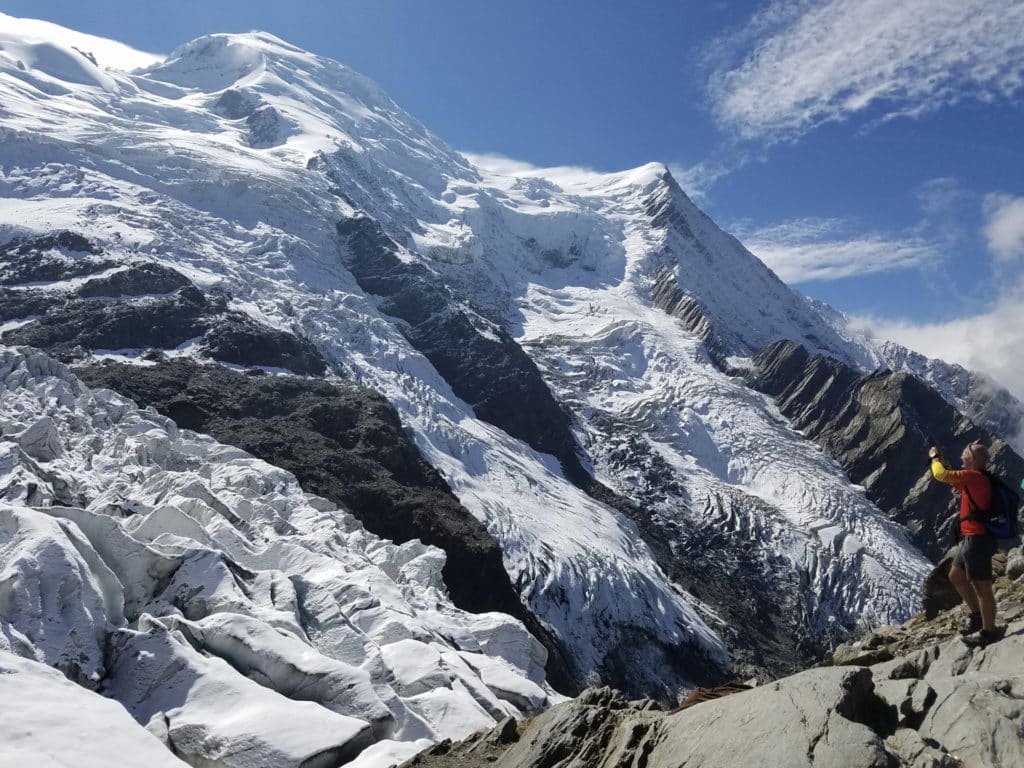
A day or two walking around the Chamonix valley is well-spent taking in the various viewpoints of this peak and its surrounding massif. Even after you depart Chamonix to begin your Haute Route tour, the glistening Mont Blanc remains in your hiking rearview mirror for several days. It is the highest peak in the Alps after all, and not many other peaks can obscure it.
A History of Alpinism
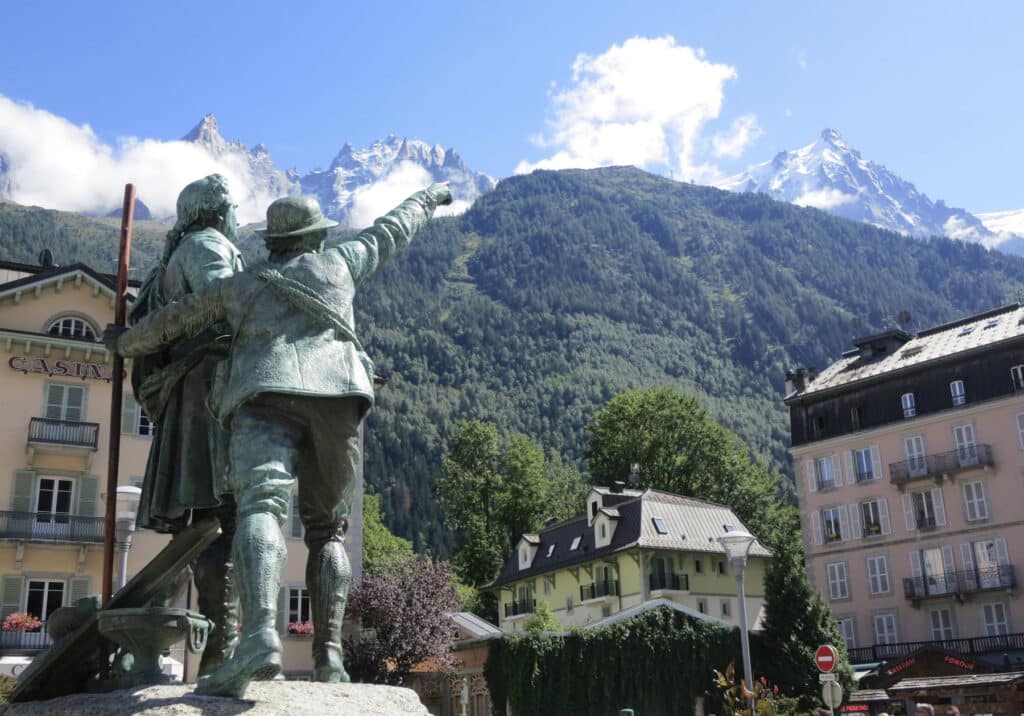
Beginning in the late 1700’s, the first attempts at summiting the great alpine peaks were a combination of adventure and scientific discovery. Driven by the Enlightenment values of scientific inquiry and empirical observation, noted Swiss geologist Horace-Bénédict de Saussure spent 27 years working to reach the peak of Mont Blanc. Ultimately unable to succeed on his own, Saussure set a reward for anyone who would be able to summit the mountain and guide him to the top. After several failed solo attempts, Jacques Balmat, a local chamois hunter and crystal collector, and Dr. Michel Gabriel Paccard succeeded in reaching the summit together on August 8, 1786. Saussure would not summit until August 3, 1787 in the third party to climb Mont Blanc led by Balmat. The second party to climb Mont Blanc? Also led by Balmat.
Modern Tourism on Mont Blanc
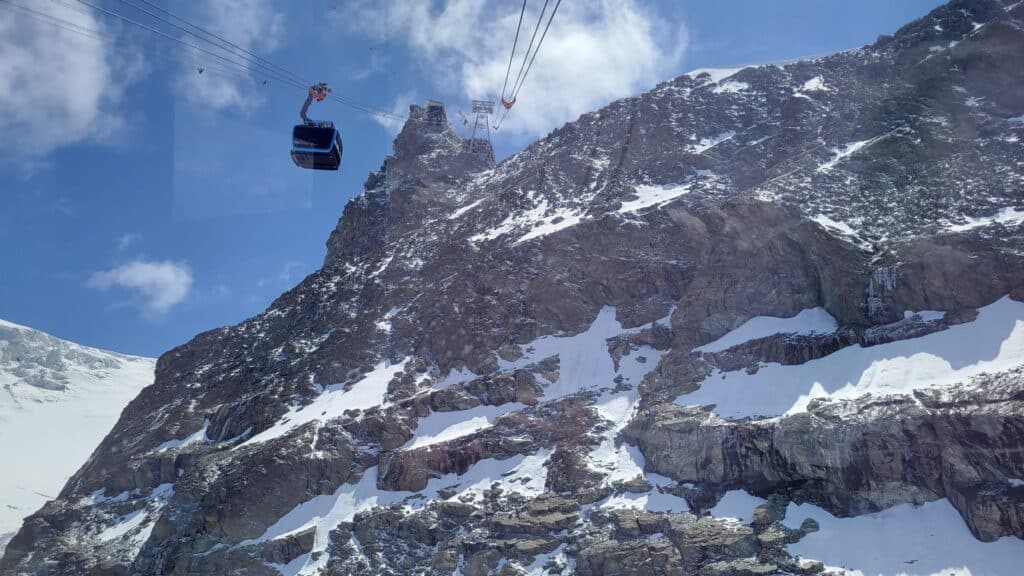
These days, climbing Mont Blanc is a very different affair. One popular route is the Mont Blanc traverse, a three day climb that passes over Mont Maudit, Mont Blanc du Tacul, and Mont Blanc. Most climbers start their journey with the Aiguille du Midi Cable Car. Completed in 1955, it has the highest vertical difference of any cable car in the world at 2807m and takes a mere 20 minutes to arrive at 3,777m. Mountaineers head out from there towards the Mer de Glace (Sea of Ice) and overnight at the Cosmiques Hut, a large “refuge” that can sleep 130 guests. At 2am most of these guests will head out on their journey over the highest peak in Western Europe.
But don’t let all this mountaineering talk sway you from heading up the Aiguille du Midi just to take in some outstanding views. There is plenty on offer for us at the Aiguille du Midi without any technical climbing skills.
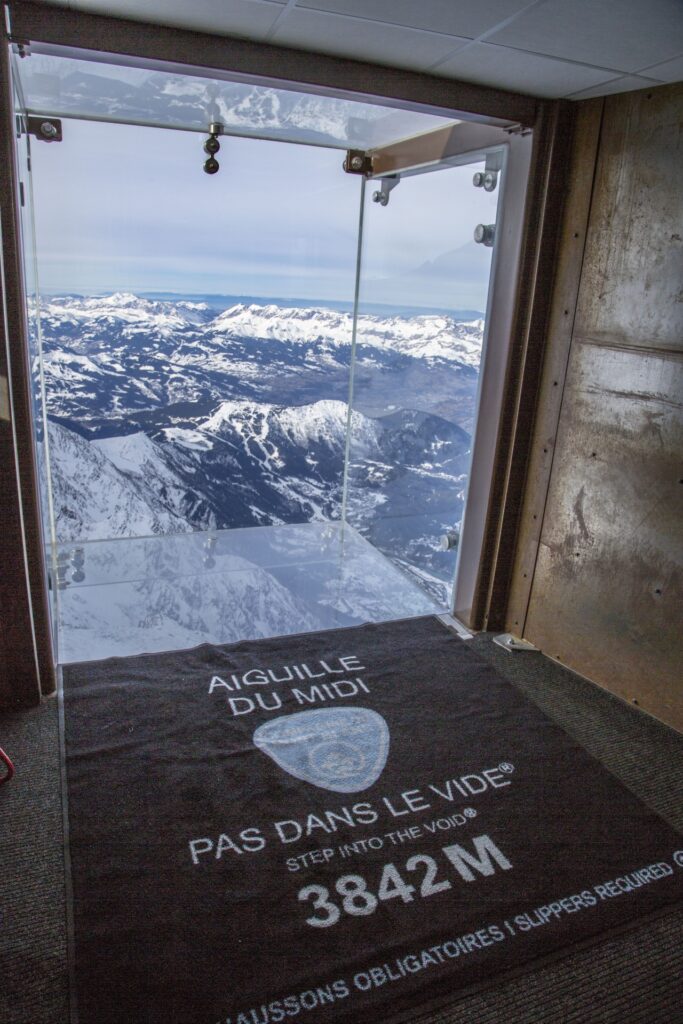
First, there’s the Pipe. A 32-meter-long steel gallery that circles the central piton of the Aiguille du Midi, the Pipe provides 360 degrees of the Mont Blanc massif. Next you can explore the Void, a glass box built onto the side of the building that you can step inside to marvel at the 1,000m+ drop below. Outside terraces provide a variety of views of the Mer de Glace, Dente del Gigante, and Mont Blanc itself. Now look west. On a sunny clear day you may even see…
The Matterhorn
The Matterhorn marks the final destination of our transalpine Haute Route adventure. Sure, you may have seen the summit from the Aiguille du Midi. And along our route we saw this peak while hiking from the Pas de Chevres. But nothing will prepare you for your first view of the Matterhorn u
p close and personal. It’s an icon for a reason, and it has a special draw even for folks more inclined to, er, less incline in their mountain rambles.
Climbing History
The first successful ascent of the Matterhorn was every bit as hard won as those on Mont Blanc, but the victory was tainted by tragedy. After eight attempts to summit the Matterhorn from the Italian side, the English mountaineer Edward Whymper moved to the Swiss side of the mountain to try again.
This time he joined with Lord Francis Douglas and retained the services of local guide Peter Taugwalder and his son by the same name. The group grew to include three other climbers: Charles Hudson, an Anglican Chaplain and mountaineer, Michel Croz, a Chamoniard Mountain Guide, and Douglas Hadow, a protege of Charles Hudson.
On July 14, 1865, the men succeeded in achieving the summit, narrowly beating out a competing team just a few hundred meters below on another face of the pyramidal peak. But too soon their descent turned into a nightmare. Equipped with only sturdy hemp rope, and the heavy canvas, leather, and wool gear of the day, the group’s margin for error was very slim. A poorly placed step led Hadow to slip and fall onto Croz, dislodging him and dragging Douglas and Hudson along with them to their deaths. A weak section of rope broke between the four doomed climbers and the last three in line, sparing the lives of Whymper and Taugwalders Senior and Junior. Immediately considered highly suspicious, an official investigation ultimately acquitted the survivors of any foul play.
Modern Tourism in Zermatt
These days an ascent of the Matterhorn holds much less drama. A series of gondolas bring mountaineers up to the Schwarzsee (Black Lake) at 2,552m. From there it is a 708m climb to the Hörnli hut. An early start the next morning lets climbers summit and get back in town in time for dinner.

For those that are less inclined to climb steep summits there are myriad ways to enjoy vistas around the Matterhorn. Of course, there are the gondolas that head up to the Schwarzsee bringing hikers to the foot of the Matterhorn. Many hikes branch off from here or you can simply enjoy a beer on the patio of the Hotel Restaurant Schwarzsee.
Alternatively, take the cable car to the Klein Matterhorn at 3883m. It almost feels like you are eye level with the Matterhorn at this elevation. Be aware, the air is thin here. Continue onward with the Matterhorn Glacier Ride 2, the highest cable car crossing in Europe which brings you down to Cervinia on the Italian side of the Matterhorn. On this side of the border, they call the peak Cervin.
Or if you’re looking for something more traditional, take the Gornergrat rack railway (pictured in the header of this post) to 3,089m. Completed in 1898, it’s the second highest railway in Europe.
The Alps boast no small number of claims to the ‘biggest’, ‘highest’, and ‘steepest’. Among their most impressive offerings, the Matterhorn and Mont Blanc stand tall.
Fun Fact
You may have first encountered the Matterhorn on a bar of Toblerone chocolate. Legislation passed in 2017 established the Matterhorn as an official Swiss national symbol. In order to use the mountain as a logo, a product must have a certain level of “Swissness”. European production of Toblerone bars moved to Slovakia in 2023. It retains its iconic triangular shape, and incredibly tasty nougat crunch, but the famous Toblerone chocolate bar no longer sports the more famous Matterhorn in its logo.